Sunday, June 30, 2019

The Sad State of Apologetics

The Sad State of Apologetics

Glenn R. Morton May 13, 2020

When I was an arrogant young 19 year old, as opposed to being an arrogant 70 year old now, I became a Christian and was surrounded by YECS. At the time, I knew no geology, barely knew physics, and I read a creationist book. I was thinking, these are Christians. They will be among the most honest people on earth. I didn’t think they would make up data (what a mistake). I didn’t think they would twist data (what a mistake). I didn’t think they would ignore data (what a mistake). Believing that what I was being told was absolute truth, and that there was no data that they would refuse to tell me, I began 17 years as a YEC.

But I was working for an oil company and was forced daily to see contradictions between what Christians were telling me and what I personally saw. In 1979-81, I was an arrogant 29 year old in charge of hiring and training geophysicists for ARCO. I had 60 people working for me and a private secretary and flew business class to colleges all over the US recruiting. And I went to CHC, the college associated with Institute of Creation Research. I met Henry Morris, Duane Gish, Steve Austin, Gerald Aardsma and others. Morris was a vapor canopy advocate and Jody Dillow had done a mathematical model of it showing that the world would be cool. I went over the math, found an error, and told Henry Morris of that error. Henry wasn’t interested. He didn’t care to hear anything that went against his view. I was learning how little YECs cared for observational data, or for being correct.

In the Genesis Flood, Henry cites a delta which formed in a matter of a few days. When I went to look up the reference what Henry didn’t tell his readers, who are obviously thinking about the Mississippi River Delta forming in a matter of days, is that Jopling’s delta is 20 feet long and 1.5 foot thick! This is egregious behavior for a Christian!

I wrote articles in the CRSQ trying to explain the problems I saw. My articles were not received well and indeed; creationists didn’t want to know the problems. In 1985 Emmett Williams became the editor of the CRSQ and I was told directly it was with the purpose to stop me from publishing in CRSQ. I must say I was disillusioned by my fellow Christians, whom I had started out believing would be truthful in all things( what a mistake).

In 1986 my last real gasp as a YEC gave a paper at the Inter. Conf. On Creationism in Pittsburgh. It was entitled, Challenges to a Young-earth. I showed geological problem after problem; and I showed pictures. I really wanted help on the issues I presented from my fellow YECS. That was not to be.

Before I went to Pittsburgh, Robert Schadewald had read a couple of my CRSQ articles, called me, and wanted to have breakfast with me and Kurt Wise. As I recall, Kurt wasn’t at breakfast but Bob introduced me to Kurt later in the day. Schadewald was an atheist, who spent his life ridiculing and ripping people from our faith. While he and I became friends, and I reviewed his posthumously published book, we never saw eye-to-eye. He always knew I was a Christian and would shake his head about it.

After I gave my talk, John Morris came up on stage to challenge what I had just said. He claimed to have “had experience” in the oil industry. I asked him what oil company he had worked for. I am going to let an account of this published in the Skeptical Inquirer in late 86 or early 87. It was written by Robert Schadewald. Of this event, Schadewald wrote:

" John Morris went to the microphone and identified himself as a petroleum geologist. He questioned Morton’s claim that pollen grains are found in salt formations, and accused Morton of sounding like an anticreationist, raising more problems than his critics could respond to in the time available.Morris said that the ICR staff is working on these problems all the time. He told Morton to quit raising problems and start solving them.
"Morton chopped him off at the ankles. Two questions, said Morton:
‘What oil company did you work for?’ Well, uh, actually Morris never worked for an oil company, but he once taught petroleum engineering at the University of Oklahoma. Second, How old is the Earth?’ 'If the earth is more than 10,000 years old then Scripture has no meaning.’ Morton then said that he had hired several graduates of Christian Heritage College, and that all of them suffered severe crises of faith. The were utterly unprepared to face the geologic facts every petroleum geologist deals with on a daily basis. Morton neglected to add that ICR is much better known for ignoring or denying problems than dealing with them. "

It is truly sad when an atheist can say this of a Christian organization. At the ICC in 1986, I was presenting the problems because I wasn’t smart enough to solve them, so John telling me to solve them, well, I was not capable, and John was not capable of correctly describing his academic and work background. I knew that John was not a petroleum geologist. We both went to Oklahoma U. and he was a year or two behind me. My roommate was friends with John at the time. If anything, he is a petroleum engineer, and those guys don’t take geology courses. They are concerned with drilling wells. I checked his Thesis and Dissertation out of the library and point it out here to document what is said above:

John’s Masters Thesis was entitled "Tidal Power State of the Art -1977

His Ph.D. was entitled, “Development and properties of a self-bursting Pellet as Agglomerated from Coal Fines by Use of an Organic Binder,” 1980

His Ph.D. dissertation includes only one legitimate geological reference "S. A. Friedman, “Investigation of the Coal reserves in the Ozarks Section of Oklahoma and their Potential Uses,” Oklahoma Geologic Survey, Special Publication 74-2, 1977.

His Masters Thesis also includes only one legitimate geological reference. D.J.P. Swift and A. K. Lyall, “Origin of the Bay of Fundy,” Marine Geology, 1968, 6, pp 331-343. A three page article on geology! Having hired about 130 geoscientists, I know this isn’t a geological thesis.

All other references are to engineering and mathematical texts. He isn’t a Ph. D. in Geology as he claimed on the Radio Show Science, Scripture and Salvation, on July 10, 1994. Why do people exaggerate their education? I don’t know. Why do Christians go light on the truth? Again, I don’t know.

When I left YEC in disgust in the in 1987, the biggest part of my disgust concerned the utter lack of interest in geologic data. I could put data in front of them, show them pictures, explain what the pictures meant, and the data was still ignored, treated as if it didn’t exist.

Sadly in my interactions with old earth Christians, I have often had the same experience. Data seems not to matter to us Christians, of any stripe and this grieves me greatly. Old earth creationists have ignored or lightly researched anthropological data which says archaics have capabilities they don’t want them to have. We all make mistakes, but when everyone makes the same mistake, what is one to think? Maybe it is that no one wants to look deeply at those issues

The fact that pain in childbirth goes WAY back to 2.4 myr, doesn’t seem concern anyone who says Eve was a Neolithic woman whom God cursed with what she already had. Same for sweat with Adam.

I had a year long debate with Fazale Rana, about art and music being much older than their arbitrary cutoff of 60,000 years. Rana was stuck on the claim that Neanderthals and H. erectus were mere spiritless animals. The data didn’t matter to their belief at the time that Adam was less than 60 kyr old. Now, after about 18 years, they finally have Adam at 150,000 years of age. They still claim N’s and H. e.'s are spiritless animals. They should have been able to know the age of Adam 30 years ago.And still there is much ignored evidence that Adam is even older than that. Same with my friend Dick Fischer. It seems that our job as apologists is to not dig too deeply into the science and present to the unsuspecting public something that can be easily disproven? That was the problem with YECs. They presented theories that could easily be disproven.

I suspect that part of this is to not run off readers, or to go along with the crowd.

Dennis Venema and Scott McKnight wrote Adam and the Genome, in which they argue against the existence of a real Adam and Eve.  They assume Adam and Eve must be H. sapiens. When we claim as Venema did in his book,  that there was no population bottleneck in the past 200 kyr, so no Adam and Eve, without even trying to look for an alternative, one must wonder what is more important–eliminating Adam and Eve or searching for other options which can make the Scripture true. The statistics he uses only apply IF Adam was a H. sapiens. If Adam was an earlier species of hominid, then Venema’s arguments fall apart. Venema’s view is based on the Out of Africa theory, which has now fallen inside of Anthropology itself. A form of multiregionalism has won the day. We have too much DNA from Neanderthals, Denisovians, and the Ghost species of West Africa.

"Until recently, the story of our origins was thought to be settled: Homo sapiens evolved in eastern Africa about 150,000 years ago, became capable of modern behaviour some 60,000 years ago and then swept out of Africa to colonise the world, completely replacing any archaic humans they encountered. But new fossils, tools and analyses of ancient and modern genomes are tearing apart that neat tale. The Jebel Irhoud skull has turned out to be a key to a new, slowly emerging paradigm. With the dust yet fully to settle, the question now is how many, if any, of our old assumptions still hold. “Should we be thinking of a completely different model?” asks Foley. “Abandoning out-of-Africa?” Strap in, it’s going to be quite a ride." Graham Lawton, "Becoming Human", New Scientist, April 3, 2019, p. 34

"If the AMH genome contains any degree of dual ancestry (that is, archaic and modern) the single origin model must be rejected. Although most of the AMH genome might descend from a single African population, if further studies confirm a non-negligible contribution of archaic genetic material to the AMH genome, it would imply that the evolutionary lineage leading to AMH did not evolve reproductive isolation from other archaic hominin subpopulations and, therefore, cannot be considered a distinct biological species." Daniel Garrigan and Michael Hammer, "Reconstructing Human Origins in the Genomic Era," Nature Genetics, 7(2006), p. 677

Well, we do have a non-negligible genetic heritage from archaic species. Eurasians have 3-4% Neanderthal genes; Papuans have about the same amount of Denisovian DNA and west Africans have 2-19% of their genes from a ghost archaic species we are still looking for.

"Similar patterns were seen in the genomes of Mende people in Sierra Leone, Esan people in Nigeria and those in western areas of Gambia. The four populations are estimated to derive between 2 and 19 per cent of their ancestry from an archaic group of genes.
...
" This mystery hominin is most likely to have diverged from the ancestors of Neanderthals, Denisovans and modern humans before that lineage split into these groups, according to the researchers. They estimate this divergence took place at some point between 1 million and 360,000 years ago, and interbreeding between the archaic population and the ancestors of the modern populations occurred at some point in the past 124,000 years." New Scientist, Feb 12, 2020,
https://www.newscientist.com/article/2233488-dna-analysis-of-people-in-west-africa-reveals-ghost-human-ancestor/#ixzz6LUHZ2qwF

If Out-of-Africa isn't dead, it has been put on a respirator.

When I left YEC in 1986, I spent loads of time looking at the data from the point of view of ‘where am I wrong?’ not ‘How is my theory correct?’ I had been egregiously wrong about YEC for 17 years or more. Thus, for the rest of my life, when I got an idea about something, the first thing I did was find out what was wrong with it. That allowed me to learn the data, but also, ensure I had solid answers for what anyone would throw at my theory. I fear, Christians don’t use that approach, but use the confirmation bias approach-- take the data if it supports the view, and ignore it if it doesn’t. The artwork I have shown from the archaic species is new information to most on this list. It shouldn’t have been.People like Ross, Rana, and others should have been at the forefront of displaying it, but doing so, undermines their claim of non-personhood for Neanderthals and thus, such data can’t be shown, ever! But pointing it out leads to unpopularity .

I can guarantee one and all, if I had my preferences, I would never have suggested the concordism approach I have–with Med flood and an extremely old Adam. I know John Walton, the OT scholar thinks I am nuts–but he wouldn’t listen long enough to see what I have to offer. He isn’t the only one. Many people just don’t respond to me. I offer my view because I firmly believe the data conforms to the theory. It makes Scripture be true rather than mythological or just plain false. Life would have been much easier for me, if I had gone along to get along with a Neolithic Adam and a Mesopotamian flood. I might even have been popular and influential.

To me the troublesome concern is, “Is ignoring evidence or lightly researching an area the way Christians should work?” and, “Is this the excellence God expects from us?” We seem not to care about Col 3:24: “Whatever you do, work at it with your whole being, for the Lord and not for men,”

On this side of the vale, we cannot prove what God did. All we can do is create theories that match the observational data. While God may tell me I am utterly wrong in a few months, I can at least stand and say I applied the best work ethic and research I could do even as I was dying. If I am wrong, it is not for lack of trying and it is not because I ignored data so as to save a popular view. I do believe we will stand before God for his judgment. I want and hope to hear, Well done…and I have done my research to the best of my ability, be it right or wrong. At least I am not telling everyone something I know to be false nor am I telling everyone something that doesn’t match the facts of geology, anthropology and physics. This should be the goal of every Christian in science.

The Genealogies of Genesis

The Genealogies of Genesis
Glenn R. Morton May 9, 2020

For the moment, lets assume that Ussher’s values are correct for the sake of argument. No matter where we put Adam, be it 12,000 years ago or 200,000 years ago, or as I do, 5.3 myr ago, there are lots and lots of gaps. The genealogies have (assuming I did my math correctly, and given the bad night last night that is not a certitude), I calculate the average generation time from Adam to Abram is 97.8 years. There are 20 people And Abram lived around 2000 BC (rounding for easy math). So Swamidass has Adam at 10,000 BC (12000 years ago), requiring a 400 years per generation value to get to Abram’s time.

This would mean we miss 3 out of 4 of the people in the genealogy.

If we believe Adam was 200,000 years ago, well, the gaps are monstrously large, and as with my view, the names could not have been handed down by oral tradition over a period of 200 kyr. They have to be there via divine inspiration. Again, if I did my math correctly we would have 1 in 101 of the names that should be there.

If we don’t believe the numbers at the birth for these patriarchs and presume that the times were more in line with modern humans, well, then we have 1 name for every 8000 or so people in the list. Once we have this much gap time in the genealogies, what is the difference or big deal about adding more people to the gap. The only function I see in the genealogies is that I think they are true but very incomplete. And this incompleteness must extend to any view that is not the view of Ussher. And we know Ussher’s chronology is wrong. As I said, both words used for begat or father of, are also used in an ancestor-descendant relationship as well.

I view the genealogies this way. When my great great grandfather gave birth to my philandering great grandfather, he at the same time he became the ancestor of all who would flow from my great grandfather, including my beloved grandfather, his sisters, his half brother(a mob boss/killer/pimp), a third half brother from a different woman(and his 14 grandkids) and one line hidden by adoption records–at least 4 different families and then my father, me, my 3 sons and my 8 grandchildren. That is what these words mean according to the way they are used.

Yalad is used in this passage:

And Canaan begat Sidon his firstborn, and Heth, 16 And the Jebusite, and the Amorite, and the Girgasite, 17 And the Hivite, and the Arkite, and the Sinite, 18 And the Arvadite, and the Zemarite, and the Hamathite

If begat here ‘yalad’ means ‘Im your real daddy’, then imagine the wife’s surprise when hundreds of people from 9 tribes pop out of her womb! No one gives birth to tribes unless they are viewing it as I said above–ancestor/descendant relationship. But every ‘ite’ I bolded is a tribe of people, not a son.

Matthew 1 tells us all we need to know about how Jewish people thought about the word ben.

the generation of Jesus Christ, the son of David, the son of Abraham

There are big gaps in that genealogy there–true but very incomplete.

If Matthew 1:1 was in hebrew it would have been:

toledoth Jeshua Meshia, ben David, ben Abraham"

Christian Anti-evolutionism in Light of DNA Evidence

Christian Anti-evolutionism in Light of DNA Evidence
Glenn R. Morton May 5, 2020

As I survey the world of views on Adam and who he was, one thing struck me while I was sick in bed last week–Christians seem to require that Adam not be evolved, that is, that he, like us, is an anatomically modern human. And the vast majority of views say Adam must have lived when the YECs say Adam must have lived–within the past 10 kyrs. Others who believe Adam was 200,000 years ago, still believe he had to be an anatomically modern human. In other words, it seems that a key modern Christian doctrine is that Adam must be physically like us. We seem to be saying that God could not put his image in anything that doesn’t look like us. I reject that view.

What evidence do I have for this claim? First, every YEC says Adam lived within the past 10,000 years, so I don’t need to discuss any of them. Their Adam is almost always considered to be an H. sapiens . Archaic species if granted human status are degenerates from Adam.

With the old earthers, Let’s start with Hugh Ross, who believes the universe evolved, but not biology. Poor Hugh has constantly but grudgingly been moving Adam backward in time.

"While bipedal, tool-using, large brained hominids roamed the earth at least as long ago as one million years, evidence for religious relics and altars dates back only 8,000 to 24,000 years . Thus the secular anthropological date for the first spirit creatures is in complete agreement with the biblical date ." Hugh Ross, The Fingerprint of God, (Orange: Promise Publishing, 1991), p. 159-160.

By 1995, Ross had moved the oldest possible Adamic date back to 60,000 years ago.

" However, the dates for these finds are well within the biblically acceptable range for the appearance of Adam and Eve __ somewhere between 10,000 and 60,000 years ago according to Bible scholars who have carefully analyzed the genealogies. Since the oldest art and fabrics date between 25,000 and 30,000 years ago, no contradiction exists between anthropology and Scripture on this issue ." Hugh Ross, “Art and Fabric Shed New Light on Human History,” Facts & Faith, 9:3 (1995)p. 2

Then in 2005 Rana and Ross say 100kyr old Adam might work out:

" Gaps in the genealogies and the ambiguity of key words in the original Hebrew text render the best attempts at a biblical date for Adam and Eve as estimates only. If few gaps exist, the date calculates to around 10,000 years ago. If many gaps occur, the date falls closer to 100,000 years ago. " Fazale Rana and Hugh Ross, Who Was Adam?, (Colorado Springs: NavPress, 2005), p.45

Today they say:

When did Adam and Eve live? … The consistency of these three independent lines of evidence instills some confidence that Adam and Eve lived somewhere between 50,000 and 150,000 years ago . This date fits within the Biblical framework and strongly argues for a recent origin of humanity. https://reasons.org/explore/publications/rtb-101/age-of-adam

But all throughout this time, they have vehemently denied that Neanderthals interbred with humanity, that Neanderthals were anything other than primates. and have insisted that Adam and Eve are anatomically modern humans–no evolution for us. From Feb 19, 2020:

"RTB’s human origins model regards Neanderthals (and other hominins) as creatures made by God, without any evolutionary connection to modern humans. " https://reasons.org/explore/blogs/the-cells-design/read/the-cells-design/2020/02/19/ancient-dna-indicates-modern-humans-are-one-of-a-kind

As we will see, RTB is hopelessly incapable of dealing with the recent DNA data. We non-Africans have Neanderthal DNA inside each of our cells.

Ok, what about people like Dick Fischer in The Origins Solution? Again, no evolution for spiritual mankind. Adam is a full-fledged H. sapiens!

" Genesis 4:22. One of Cain’s descendants, Tubal-Cain, was ‘an instructor of every worker in brass and iron.’

"This is the proverbial smoking gun! Adam belongs after the old Stone Ages, at the end of the Neolithic, at the threshold of a period called the Chalcolithic when traditional stone tools were augmented by crude copper implements. Adam’s descendants saw the dawning of the Bronze Age ." ~ Dick Fischer, The Origins Solution, (Lima, Ohio: Fairway Press, 1996), p. 239

As I explain here, brass and iron is a euphemism for corruption. and in the post after that, an even better explanation for the corruption analogy is presented by Phil McCurdy. But regardless, Dick posits Adam as one of us. People alive at the end of the Neolithic were, H. sapiens , that is, modern humans. Again, Christians of the old earth variety require that Adam be physically like us, and living when YECs say he did!

My friend Jay Johnson told me last year that the population which got the image of God, language and morality, lived 65-75,000 years ago–again, these were modern humans because he cited the globularity of their brains and connected it to language. Erectine brains when viewed from above, look like a distorted hour-glass. They are not globular.

Interestingly, Swamidass also places Adam as a very recent person on earth, say around 12,000 years ago. It seems that he and Venema, while disagreeing on the nature of Adam, agree that he was an H. sapiens.

Dennis Venema, a person of esteem here on Biologos said:

" In Adam and the Genome I consistently discuss humans as a species arising ~200,000 years ago. So, by your calculations, Zhao (2000) supports my case - human variation in this all region of the genome cannot be reasonably explained by a bottleneck to 2 individuals within human history, as I argue in AatG. Am I missing something here? I want to be sure I’m reading you correctly." Adam, Eve and Population Genetics: A Reply to Dr. Richard Buggs (Part 1)

He and Scot McKnight wrote the book mentioned above. Venema uses the minimum effective population size of modern humans as a hammer to pound the historical Adam and Eve out of the Bible. No bottle neck of 2 people has happened in human history. But those statistics only apply to the last 200,000 years of anatomically modern man. What if Adam wasn’t an anatomically modern human, and we Christians fully accept our evolutionary heritage rather than acting as if God can only put the his image into a vessel that looks like us?

George Murphy gets confused when he addresses this issue. He uses the statistics above, which are applicable only to anatomically modern people and then discusses briefly other hominids being human. He cites a problem I had worried about for about 20 years before finding a solution–the Major Histocompatibility Complex.

" The theological proposal to be made here does not depend on the number of hominids to be considered the first humans or on when they came into being. But it does seem unlikely that the present human race can be traced to a single male-female pair. As one example of the difficulty this idea faces, development of the present diversity of alleles of human histocompatibility genes from such a pair would require between five and ten million years. Unless we want to consider ’ Adam and Eve ’ the biological ancestors of all hominids, and perhaps even pongids, we must rule this out . "George L Murphy, Roads to Paradise and Perdition: Christ, Evolution, and Original Sin, Perspectives on Science and Christian Faith, June 2006, p. 114

While I do want to declare Adam and Eve the parents of the hominids, I wouldn’t go so far as the pongids, nor do I think we need to. Like George, I worried about the Major histocompatibility complex and its implications for not allowing a population bottleneck of two people. At the time I wrote my book, Adam, Apes and Anthropology, the widespread view among many atheists I knew at the time was that of Ayala:

" The human immune system DRB1 genes are extremely polymorphic, with gene lineages that coalesce into an ancestor who lived around 60 million years ago, a time before the divergence of the apes from the Old World monkeys ." Francis J. Ayala, “The Myth of Eve: Molecular Biology and Human Origins,” Science, 270(1995):1930-1936, p. 1932

Now obviously that won’t do. George gave up on the problem too early. The answer was out there shortly after I wrote my book and long before George wrote the above article. I, however didn’t find out about it until about a year and a half ago. Ayala’s calculation was based upon single nucleotide mutation driving the entire MHC polymorphism, which would indeed take 60 myr. But in 1998 it was discovered that both cross-over and recombination occurs in the MHC regions:

" Some new alleles are the result of point mutations, but many arise from the combination of sequences from different alleles either by genetic recombination or by gene conversion, a process in which one sequence is replaced, in part, by another from a different gene (Fig. 5.19). " Janeway CA Jr, Travers P, Walport M, et a, Immunobiology: The Immune System in Health and Disease. 5th edition. https://www.ncbi.nlm.nih.gov/books/NBK27156/

" Sequences can be transferred from one gene to a similar but different gene by a process known as gene conversion. For this to happen, the two genes must become apposed during meiosis. This can occur as a consequence of the misalignment of the two paired homologous chromosomes when there are many copies of similar genes arrayed in tandem - somewhat like buttoning in the wrong buttonhole. During the process of crossing-over and DNA recombination, a DNA sequence from one chromosome is sometimes copied to the other, replacing the original sequence. In this way several nucleotide changes can be inserted all at once into a gene and can cause several simultaneous amino acid changes between the new gene sequence and the original gene. Because of the similarity of the MHC genes to each other and their close linkage, gene conversion has occurred many times in the evolution of MHC alleles ." Janeway CA Jr, Travers P, Walport M, et a, Immunobiology: The Immune System in Health and Disease. 5th edition. https://www.ncbi.nlm.nih.gov/books/NBK27156/

Once one throws gene conversion and recombination into the mechanisms of how to form MHC diversity, one can no longer use the rate of point mutation to date the age of the MHC alleles. In both processes, multiple nucleotides are traded at each gene conversion and crossing over/recombination. This clearly means that the rate of creation of alleles is much faster than point mutations and the age of the complex is much younger than 60 myr, and maybe undatable…

Once this MHC issue is gone we have no real obstacle to a single pair except our own bias. Most people don’t know that there is no definition of modernity which includes all modern humans and excludes all archaic species:

" The main problem with modernity, we think, is reflected in the fact that there is no worldwide definition of moderns that simultaneously includes all modern humans and excludes all archaics. If modern humans share a recent unique origin, definition of this group should be possible. However, it may not be possible if the multiregional model is correct." ~ Milford Wolpoff and Rachel Caspari, “The Modernity Mess,” Journal of Human Evolution, (1996), 30:167-171, p. 169

Indeed, a form of multiregionalism is now in vogue, where Neanderthals, Denisovians and a ghost archaic in Africa interbred with moderns. Were the offspring moderns? Given that some of their descendants are alive today would strongly suggest that. By comparison to other animals we can illustrate the problem:

" We feel that this quest for the beginnings of modernity is doomed to failure; we are seeking something that doesn’t exist. It is time, as P.V. Tobias recently said, to stop talking about ‘anatomically modern humans’ for the same reasons that we don’t talk about 'anatomically modern elephants '. And we propose, it is time to stop publishing papers about the evolution of ‘anatomically modern humans’ unless they include a definition of them. " ~ Milford Wolpoff and Rachel Caspari, “The Modernity Mess,” Journal of Human Evolution, (1996), 30:167-171, p. 170

Very OLD Genes

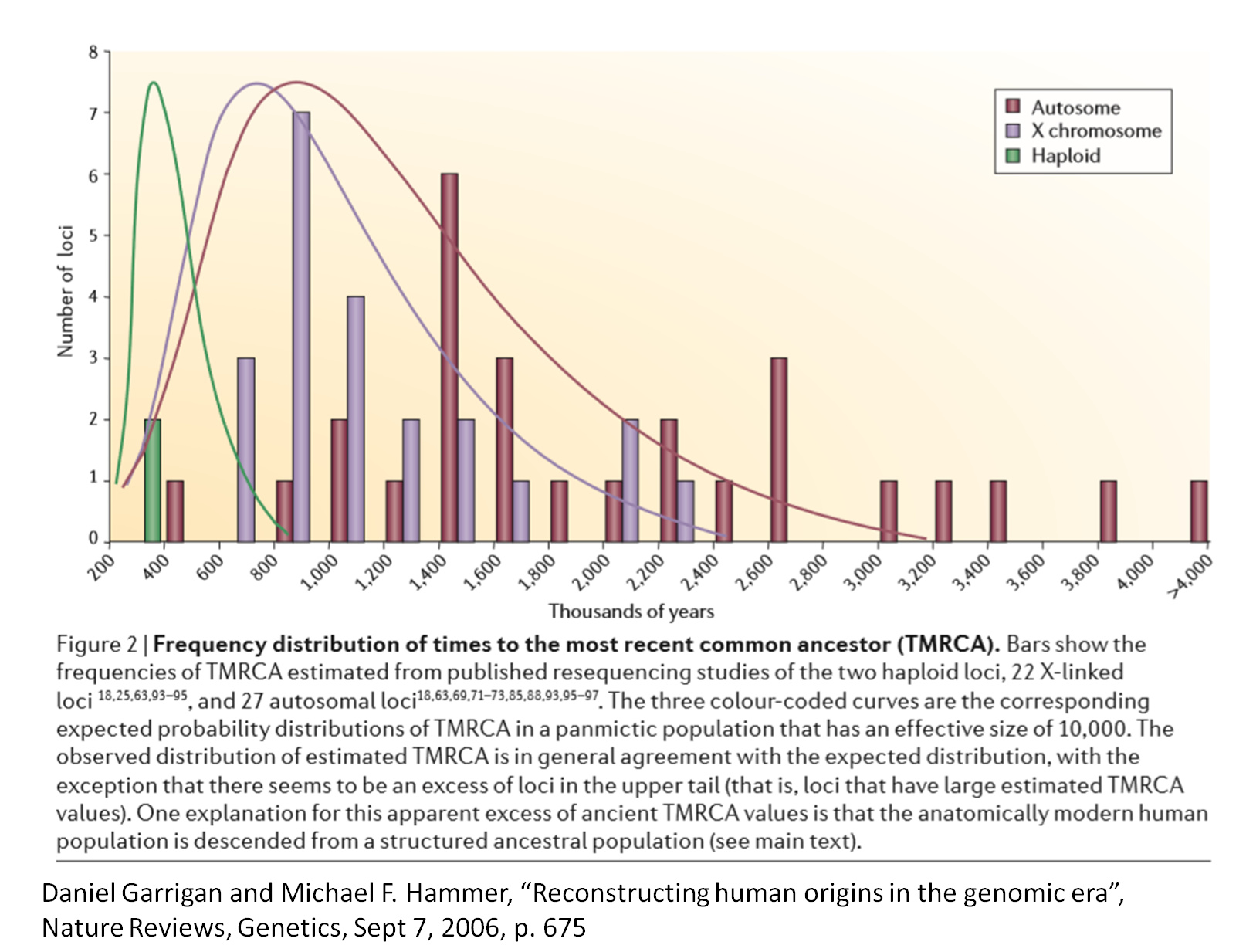
Moving Adam and Eve back in time, like I do, to 5.3 myr ago, we can have a historical Adam, and an evolutionary humanity. And we can explain the significant number of extremely old genes in humanity (old= old time to most recent common ancestor, like genes greater than 4 myr old). Garrigan and show the age of various genes.


One can see the haploid mtDNA and y-chromosome measurements are only for a very recent time scale and tell us nothing about when humanity arose. The average age of an autosomal gene is about a million years! Anatomically modern humans were not alive then, but we still have genes from those non-anatomically modern humans. The X chromosome and the other autosomal chromosomes show a great genetic time depth for humanity–a time depth Christians seem unwilling to grant.

Garrigan and Hammer suggest that if we modern humans interbred with archaic species, then that would mean we were never an isolated reproductive species.

" If the AMH genome contains any degree of dual ancestry (that is, archaic and modern) the single origin model must be rejected. Although most of the AMH genome might descend from a single African population, if further studies confirm a non-negligible contribution of archaic genetic material to the AMH genome , it would imply that the evolutionary lineage leading to AMH did not evolve reproductive isolation from other archaic hominin subpopulations and, therefore, cannot be considered a distinct biological species. " Daniel Garrigan and Michael Hammer, “Reconstructing Human Origins in the Genomic Era,” Nature Genetics, 7(2006), p. 677

Well, we have non-negligible input from at least 3 archaic populations, Neanderthals, Denisovians and a ghost population from Africa. And there is evidence that the Denisovans interbred with an even older archic from 1.8 myr ago. Asians and Europeans have 1.7 and 1.8 percent Neanderthal DNA respectively. Africans have .5% Neanderthal DNA. Melanesians, Australian aborigines, and polynesians have between 2 and 6% Denisovian DNA. (Wiki) . This year genetic evidence for an unknown archaic having interbred with some West African tribes. Anthropologists don’t know who this archaic is. But the genomes of the Mende of Sierra Leone, the Esan of Nigeria and the Yoruba of Nigeria, have from 2-19 percent of their genomes from this unknown archaic hominid.(see https://advances.sciencemag.org/content/6/7/eaax5097)

While Wiki doesn't yet have this archaic-human interaction in West Africa yet (it is too new), this chart shows that we are not and never have been an isolated breeding species.  It shows two further archaic/human interbreeding events with the Khoisan  (see https://phys.org/news/2019-04-african-populations-crossbred-extinct-humans.html)

picture from https://en.wikipedia.org/wiki/Interbreeding_between_archaic_and_modern_humans

Because the main place where Denisovian dna introgressed into humanity was in Papua New Guinea and Australia, Cooper and Stringer wonder if the Denisovians crossed the Wallace line and that would mean building steerable ships.

The data challenges our views of the capacities of the archaic populations, the data challenges our view of when Adam and Eve lived, and the data totally messes up the nice picture we Christians have of a recent Adam living less than 200,000 years ago. Christians have long ignored this data pointing to our ancient roots, denying God the ability to put his image into whatever he wishes to–as Jesus indicated on Palm Sunday that God could make rocks stand up and cheer. The form of anatomically modern humans is not what makes us special–it is the image of God.

Until Christians are willing to actually deal with the genetic data showing that our origins are from millions of years ago, we will be like the YECs, ignoring data to maintain our preferred theological view of a recent Adam.

Both Adam and Eve's curses Are Curses for Bigger Brains

Note: I am breaking this out from an earlier post to make this subject on its own.
Johnny-come-Lately, The Curse, Brain-size, Pain and Sweating
Glenn R. Morton April 25,2020
Above I have spent some time defending the big brained scenario for what species Adam and Eve were.  Some people might prefer that view.  Below, I am going to use a Biblical reason for  why I believe Adam and Eve had a brain-size about half our present value or smaller.. At this point I am shifting to look not at the scientific evidence but at the Biblical evidence. I think one of the interesting possible interpretations of Scripture has been totally overlooked for millennia.  Most didn't have the scientific knowledge to understand what it said, but for the past 100 years we have and no one seems to have seen it.  Both the woman's curse and the man's curse in Genesis 3 involve a future big brain!
Most liberal Christians (defined as not believing there is any scientific/historical information in Genesis 1-4), place Adam within the past 10,000 years. Such a position for Adam makes an utter laughing stock of everything done and said in Genesis 3. That is, assuming they believe Adam was an individual rather than a population.  I call this the Johnny-come-lately Adam because he is really too late in time, even by Biblical evidence.  Let's look at some of the things Johnny- come-lately Adam is too late for.
Sally-come-lately Eve is too late for pain in childbirth to mean anything.
Pain in Childbirth Genesis 3:16:To the woman He said, “I will greatly multiply Your pain in childbirth," (NASB)
If someone cursed me right now with having trouble walking, it would mean nothing.  I  already HAVE trouble walking from side effects of a drug trial. Or if they cursed my hair to turn gray when it is already gray, or as a friend said, 'it would be the same as if He cursed you with ugliness."  LOL, So, big deal.
That must be how Sally-come-lately Eve felt when God told her she would have increased pain in childbirth. Sally-come-lately Eve would say:  "Big Deal. Big Guy!  Haven't you heard millennia of screaming women in labor who are cursing what their husbands did to them?"   Thus, the curse is no curse at all!
Further Gen 3:20 says Eve was "Mother of all living." Sally-come-lately Eve certainly couldn't have been the mother of all the other women alive with her, 10,000 years ago in the Neolithic. Nor could she be the mother of all living  until maybe the last century or two. Why? The other day I spoke about Tasmanians being isolated from the rest of humanity from about 12,000 years to 1642 AD.(1) To say Eve was the mother of all living 10,000 years ago would have been a farce, yet that is what the liberal position on Genesis does to it. It makes everything a farce.  Let's go back to looking at the pain in childbirth issue.
Pain in childbirth arises from the size of the baby's head vs the size of the birth canal.  Bipedalism requires that the legs be close enough together so that the person can walk without a waddle. But this causes the pelvic opening to be small. Intelligence requires large brains and thus large cranial sizes. These two conflicting features lead to the tight fit of the infant through the birth canal. Wendy Trevathan wrote a book advocating that the problems relating to human deliveries and  produced selective pressures which led to the nearly universal human practice of midwifery. Further, the change from the ape style birth to the human style birth required that the large brained infant be born prematurely and spend much of what would be neonatal time outside the womb, increasing the intelligence of the infant, who has a world of sensory perception while the brain is developing.
"The human pattern of pre-and post-natal brain growth and development is very unusual relative both to other mammals and to other primates.  At birth, human babies' brains are small--only about 30% of their adult size, as opposed to about 50% in other primates--although their gestation time is long for an animal of their body size.  Unlike other living species, humans maintain the pre-natal rate of brain growth for approximately a year after birth, resulting in an unusually large brain size relative to body size."(2)
Basically we are born a year too early. Most other primates with small brains, give birth to infants with brains 1/2 of the adult size, but if humans did that, no woman would be able to walk, or, alternatively no child would survive birth. Thus, human infants are born with brains 1/3 the size of the adult and yet still it is a tight fit through the birth canal.
"A modern human baby, with its large skull, negotiates the birth canal by entering with the head oriented transversely.  It then rotates 90 degrees into a sagittal position before  exiting the canal facing the sacrum, that is, with its back toward the mother's face.  A human mother is therefore in a bad position to assist in delivery, since her infant is exiting 'down and back,' away from her helping hands.  Furthermore, pulling an emerging human infant up toward the mother's breast would bend it against the normal flexion of its body and would possibly result in injury.  Interestingly, the human delivery pattern is very different from that of nonhuman primates, in which there is no fetal rotation (babies are sagitally oriented throughout birth) and newborns exit the canal face-to-face with their mothers.  In this pattern, mother monkeys and apes routinely assist in delivery by reaching down and pulling emerging infants up and toward their chests in a curve that matches the normal flexion of the babies' bodies.(3)
So monkey and apes can pull their own babies out of the birth canal, human mother's can't. they need help in bad situations.  How long has this birth pattern been in existence? At least since the time of H. erectus 1.6 million years ago . The famous Lucy (AL 288-1) didn't have this problem. Ruff comments.
"It has been cogently argued by Tague & Lovejoy (1986), based on the obstetric pelvis of AL 288-1, that birth in Australopithecus afarensis would have occurred with the fetal cranium in a transverse orientation throughout, i.e., without the pelvic rotation characteristic of modern humans, and that secondary altriciality of the infant need not have been present.  In contrast, based on the relatively small size of the birth canal of KNM-WT 15000, it has been argued that secondary altriciality must have been present in Homo erectus, i.e., that the infant must have been born in a relatively helpless state.  Furthermore, the anthropoid shape of the pelvic inlet/outlet in this male juvenile, even allowing for growth to adulthood and sexual dimorphism in pelvic shape, indicates that a transverse non-rotational birth mechanism would have been highly improbable." (4)
Because of this data, it makes much more sense that Eve have been a small brained  hominid because otherwise there is no meaning to the curse of increasing her pain in childbirth.  She would have already had it.
Johnny-come-lately Adam is too late for his curse too
Genesis 3:19 says: By the sweat of your brow you will eat your food.
It is fascinating that Adam is cursed with sweat.  A Johnny come lately Adam couldn't be cursed with sweat because he already had the human sweating mechanism.  Adam would say, "Big Deal, Big Guy! Have you seen what all humans have to do to earn a living here in the hot Neolithic summers?" 
The rest of this section is from an old web page of mine on sweat. It is no longer up:
Dean Falk, one of the world's leading authorities on hominid brains, advanced a theory in which the hominid brain could not grow any bigger than the cooling system attached to it. The theory originated from a comment by her mechanic. She writes:
"It was an 'aha' experience, if ever I've had one, and the weirdest combination of events led to it. First, the engine in my 1970 Mercedes needed major surgery. I took it to Walter Anwander (a whiz) in Lafayette, Indiana, who completely rebuilt the engine. One day, while enumerating the wonders beneath the hood (about which I definitely needed schooling), Walter pointed to the radiator and told me 'the engine can only be as big as that can cool.' I didn't think much about it at the time.(5)
The brain, like that engine, can only be as big as the cooling system it has. If the brain overheats, the brain is ruined just like overheating a car engine will ruin it. In the brain the blood acts as the coolant. The brain has several emissary veins which go from the interior of the skull to the skin of the face. These veins are part of the "radiator" system. When a person is cold, blood flows from the cranium outward in these veins. But when a person exercises and becomes overheated, the blood flow reverses and blood flows into the cranium. The reason for this reversal is that the skin of the face (the brow included) acts as a radiator, cooling the blood which then enters the brain to cool that organ. Some of the veins are preserved in the skulls of extinct hominids (and man) in the form of emissary foramina (a foramina is a hole in the skull (6). Thus a record of the size and number of emissary foramina are preserved in ancient skulls for anthropologists to examine. Falk notes:
"It was beautiful. For the past two million years, the increase in frequencies of emissary foramina kept exact pace with the sharp increase in brain size in Homo. Clearly, the brain and the veins had evolved rapidly and together. I saw that Cabanac's letter was right and that I had unwittingly charted the evolution of a radiator for the brain in my earlier work on emissary foramina. As Anwander had said about my car, the engine can only be as big as the radiator can cool. Apparently, the same is true for heat-sensitive brains."(7)
But emissary veins are only part of the cooling mechanism in mankind. Sweat is the reason that the facial skin cools and the cooling of the skin cools the blood destined for the brain. What do we know about sweat?
The human sweating system is unique among mammals. Bernard Campbell describes the function of sweat glands:
"The sweat glands fall into two groups: the apocrine and eccrine glands. The apocrine glands secrete the odorous component of sweat and are primarily scent glands that respond to stress or sexual stimulation. Before the development of artificial scents and deodorants, they no doubt played an important role in human society. In modern man these glands occur only in certain areas of the body, in particular in the armpits, the navel, the anal and genital areas, the nipples, and the ears. Surprisingly enough, glands in the armpits of man are more numerous per unit area than in any other animal. There is no doubt that the function of scent in sexual encounter is of the greatest importance even in the higher primates and man. "The eccrine glands, which are the source of sweat itself, have two functions in primates. Their original function was probably to moisten friction surfaces, such as the volar pads of hand and foot to improve the grip, prevent flaking of the horny layer of the skin, and assist tactile sensitivity. Glands serving that function are also found on the hairless surface of the prehensile tail of New World monkeys and on the knuckles of gorilla and chimpanzee hands, which they use in quadrupedal walking. Glands in these positions are under the control of the brain and adrenal bodies, and in modern man an experience of stress may produce sweaty palms.
       "The second and more recently evolved function of the eccrine glands is the lowering of body temperature through the evaporation of sweat on the surface of the body. The hairy skin of monkeys and apes carries eccrine glands, but they are neither so active nor so numerous as in man. Modern man is equipped with between two and five million active sweat glands, and they play a vital part in cooling the body. The heat loss that results from the evaporation of water from a surface is enormously greater than that which could be expected to occur as a result of simple radiation. The fact that sweat contains salt necessitates a constant supply of the mineral if man is to survive in a tropical climate.
       "It has been observed that like almost all mammals, primates sweat very little. Even hunting carnivores, such as dogs, lose heat by other means, such as panting. Sweating has evolved as a most important means of heat loss in man, a fact that is surely correlated with the loss of his body hair. The apparent importance in human evolution of achieving an effective means of heat loss indicates without doubt that early man was subject to intense muscular activity, with the production of much metabolic heat; he could not afford even the smallest variation in body temperature. With such a highly evolved brain, the maintenance of a really constant internal environment was a need of prime importance in human evolution.
"(8)
With this need to dissipate heat in order to maintain a constant brain temperature, hair becomes a problem. Hair traps the sweat and hinders evaporation. Zihlman and Cohn relate:
"How might early hominids have dissipated the heat load generated internally, as well as externally from the sun? One way is through the skin. The skin of modern humans contrasts with that of other, nonhuman primates in four features: 1) humans have a great density (over two million) of functioning eccrine sweat glands over the entire body surface; 2) loss of the apocrine sweat glands has been associated with hair loss, and has occurred except in the ano-genital and axillary regions; 3) hair follicles are diffuse and hair shafts are noticeably reduced in size; 4) skin pigment ranges from dark to light.         "How might these features be interpreted in a functional and evolutionary way? There is the remarkable thermo-regulatory function of eccrine sweat glands. Sweating can deliver two litres of water to the skin surface in two hours and carry off almost 600 calories of heat. Hair tends to trap moisture, so that sweat evaporation is more effective with reduced hair. Interestingly, the number of hair follicles in humans is similar to that in chimpanzees and gorillas, but the much reduced size of hair shafts in humans gives a hairless appearance."(9)
Why do we have hair on our head? Zihlman and Cohninform us:
"Hair retention on the head is probably important in protecting the scalp from the sun's ultraviolet rays and may assist in stabilizing the temperature of the brain. Human populations are variable in the amount of body hair present, but in all of them the skin surface is hairless enough to permit efficient heat loss from sweating."(10)
Radiatively, hair on the top of the head absorbs the solar heat and re-radiates most of it. An absorbing layer can reduce by half the amount of energy reaching the top of the skull.
When is it likely that mankind needed this cooling mechanism for heat removal? Probably fairly early. For modern men even moderate exertion on the savanna increases the heat production by 100% over the resting levels. Since Homo erectus was as large as we are(11), similar exertions on the plains would yield similar heating. Even the smallest Homo erectus has a brain which is over twice as large as that of the chimpanzee which can get by without sweating. Homo erectus would need to sweat. Since he needed to sweat, then he needed to be relatively hairless as we are.
If he were relatively hairless, then the Homo erectus who lived in Georgia (former USSR)(12) would have been ill-equipped to handle the winter temperatures below zero Fahrenheit which occur from time to time in that area. He would have needed clothing. Because of these considerations, Anthropologists like Brian Fagan were forced to conclude,
"For Homo erectus to be able to adapt to the more temperate climate of Europe and Asia, it was necessary not only to tame fire but to have both effective shelter and clothing to protect against heat loss. Homo erectus probably survived the winters by maintaining permanent fires, and by storing dried meat and other foods for use in the lean months."(13)
This is a very human set of behaviors and Homo erectus was found in European Georgia 1.6 million years ago.
Now to tie up the final item, pain in childbirth. Among mammals there are two patterns of brain growth. The first pattern is called altriciality. In this pattern the animal is born helpless and extremely immature. The brains of altricial animals are usually half the size of the adult's, and double in size by adulthood. Because of this it takes lots of parental effort to raise the young. Animals following this pattern usually have litters and perform this care for multiple offspring at once. Cats, with their blind and helpless kittens are altricial. The other pattern is precocial. In this pattern the offspring are usually born single and from birth are able to get around quite well. Their brains are nearly adult size at birth. The are alert and all their organs are functioning. An example of this pattern is the horse, the wildebeest etc., where the young will run with the herds within minutes.
Now, according to Walker and Shipman(14), altricial species almost never have bigger brains than precocial species. The reason is that for all mammals save one, the brain grows rapidly during gestation but then grows less rapidly after birth. There is a kink in the graph of brain size vs. time which occurs at birth. Altricial species whose immature state at birth and subsequent slow down in the rate of growth forever remain behind the more maturely born precocial species.
What humans seem to have accomplished is the trick of keeping the brain growing at the embryonic rate for one year after birth. Effectively, if humans are a fundamentally precocial species, our gestation is (or should be) 21 months. However, no mother could possibly pass a year old baby's head through the birth canal. Thus, human babies are born "early" to avoid the death of the mother. Walker and Shipman write:
"Humans are simply born too early in their development, at the time when their heads will still fit through their mothers' birth canals. As babies' brains grow, during this extrauterine year of fetal life, so do their bodies. About the time of the infant's first birthday, the period of fetal brain growth terminates, coinciding with the beginnings of speech and the mastery of erect posture and bipedal walking.(15)
This pattern of growth has huge implications. Every other primate doubles their brain weight from birth to adulthood. But due to the early birth of humans, we triple our brain's birth rate. Our last 12 month of fetal growth rate of the brain occurs outside the sensorially deprived womb. The vast quantities of sensory input during the first year of life affects the rate and nature of the neural connections. Because of this year of helplessness, parents must provide close physical and emotional support for the infant. Unlike chimp babies who can cling to their mother's fur, human infants cannot even hang on to mother in spite of having the hand reflex. The mother has no fur because she sweats and she sweats because of a big brain which is why she gives birth to her child early. This early birth then requires the mother to care for the infant and increases the bond between mother and child which partially makes us human.
So, what is the birth pattern in Homo erectus? It is human. Shipman and Walker(16) point out that the adult Homo erectus cranial capacity was 950 cc. If they followed the ape-like pattern of doubling their brain size after birth, they would need to be born with a brain size of around 400 cc. Following the discovery of a nearly complete Homo erectus skeleton, the approximate size the erectus birth canal is known. A head with a 400 cc brain is 10 cm too big to fit through the birth canal. Estimates place the maximum fetal brain size able to fit through the erectus birth canal at just 231 cc(17). Homo erectus had a human pattern of birth and must have endured similar pain in childbirth.
A  study of Homo rudolfensis which lived eight hundred thousand years earlier than the 1.6-million-year-old Homo erectus studied by Walker and Shipman above, also had a human birth pattern of trebling its brain size from birth to adulthood. Homo rudolfensis stood about 5 foot 8 inches tall and was quite human in form below the neck(18). Steven M. Stanley showed that the birth canal of a Homo rudolfensis would only be able to pass a fetal head of about 210 cc. The adult of this species had brain sizes in the range of 760 to 900 cc. This data would strongly imply that pain in childbirth of the type experienced by human mothers extends back at least 2.4 million years to the initial appearance of Homo rudolfensis.(19) The birth pattern means that Homo rudolfensis children would also be born as helpless as any human or erectus baby which would require long periods intensive care. This would lead to an intense period of bonding between mother and child as also occurs among humans. And the enlarged brain would most likely have meant hairlessness among the rudolfensis also. In short, this birth pattern means they had many of our traits which are theologically associated with the Fall.
To close, it would appear that there is a single underlying cause of God's curse for the man and woman and it is an increase in brain size. This increase also caused the loss of hair requiring clothing when mankind eventually inhabited northern climes. Homo erectus is found in European Georgia 1.6 million years ago. Without fire or clothing, he would have been unlikely to survive the more severe winters in that area.
The fact that Homo erectus and Homo rudolfensis were saddled with the problems given to Adam and Eve after the fall has theological implications for the status of Homo erectus and Homo rudolfensis, the time during which Adam lived as well as who is eligible for salvation. I have long contended that humanity in the theological sense is much older than most Christians are willing to admit. If sweat and increased pain in childbirth and clothing are not signifying of humanity and the Fall, what then does theologically separate us from mere animals?
It is also intriguing to me that the ancient Hebrew writer would choose as a curse for man and woman, two different maledictions which can be caused by a single phenomenon--an increase in brain size. This single cause also would require the loss of hair and the subsequent need for clothing. There is no way that the Hebrew writer could have had the knowledge to purposefully construct this tale. Is this a fortuitous conjunction of statements or is it divine inspiration? I firmly believe God inspired the writer and while he didn't understand it, we can today.
Johnny-come-lately is too late for Language creation
Genesis 2:19-20 says:
19 Out of the ground the LORD God formed every beast of the field and every bird of the sky, and brought them to the man to see what he would call them; and whatever the man called a living creature, that was its name.
20The man gave names to all the cattle, and to the birds of the sky, and to every beast of the field, but for Adam there was not found a helper suitable for him. (NASB)
This verse describes language creation.  When I learned Mandarin, I went around China pointing and saying in Chinese, "How do you say that in Chinese?"  They would tell me the word and thus I learned Mandarin.  In Adam's case, he was creating the language and God showed him something and asked Adam to give it a name.  But regardless of the difference, this is language creation. A Neolithic farmer had no need of all this. Are we really expected to ignore what the Bible says about language here and blithely believe that Adam was a 10,000 years ago, farmer, who already had all the farm animals words down?  He would have known the words for cows, sheep pigs etc?  Thus, what is this all about in that setting--not much that I can think of. Besides language is much older than 10,000 years ago.
Our language requires both brain and vocal cord structures so as to allow us to make the sounds we do.  One mistake that is often made is that if some fossil species couldn't make all the sounds we make, therefore they couldn't have a language at all.  That is poppycock, they couldn't have a language like ours, but it doesn't rule out all possible languages. Lieberman claimed that Neanderthals couldn't have had a language because they couldn't make all our vowel sounds. It is all based upon his reconstruction of the Neanderthal vocal tract,  Campbell writes of this issue,
"His reconstructions have been challenged.  It has to be admitted that reconstructing voiceboxes from the angle of skulls on vertebral columns, basicranial morphology, and the shape of mandibles is bound to lead to controversy.  More recently the hyoid bone, which forms the Adam's apple, has been studied in detail in the Kebara Neanderthal.,  There is no significant difference from modern examples, and it is suggested that the larynx beneath the hyoid has also been unchanged for at least the past 60,000 years.  "Speech and language require more than a voicebox.  Lateralization of the brain is also a necessary but not sufficient requirement, with Broca and Wernicke's areas controlling speech in the dominant hemisphere.  In particular Broca's area, as Passingham shows, controls the sequencing of the vocal cords and directs them according to context.  This adds up to extreme vocal skills.  The earliest brain cast showing Broca's area comes from the 1470 Homo habilis skull from Koobi Fora.  Indications of asymmetry, and hence lateralization in the brain, have been traced through preferred handedness in the manufacture of stone tools as well as endocasts of the brain of Homo erectus to 1.5 Myr."(20)
I chose this quote because it talks both about the fact that the Neanderthal hyoid bone (critical to language) is identical to ours and because it talks about the earliest evidence for the language center of the brain--Broca's area. In all other areas of paleontology if two species descended from a common ancestor have the same trait, it is usually claimed that the parent species had that trait and gave it to the two daughter populations.  Neanderthal and modern human vocal tracts contain identically shaped hyoid bones, yet some want to say we can talk but they can't, and neither can the parent species.  We, cats, dogs, bats, dolphins, etc have 5 fingered hands because we are all descended from an animal that had the pentadactyl plan.  Same with us and the Neanderthal's hyoid bone. We both descended from a being with this shaped hyoid bone. It really is too much to think it evolved this way independently in two different lineages.
Given the Bruniquel religious site, deep in a cave, it is pretty clear that Neanderthals had language 176,000 years ago and even the worst case anthropologists believe humans developed language 50,000 years ago at the explosion of blade technology and art in Europe.  So, no matter how one cuts the matter, Adam is far to late to be creating a language when he grew up with one.
Secondly, one must ask why the KNM-ER 1470 H. habilis had an enlarged speech center in his brain.  What was he doing with it?  Some have suggested this guy had language.
"Leakey (1994) supposed that a protolanguage might have been produced by Homo habilis on the grounds that Broca’s area and cerebral asymmetries in modern human brain were found on the skull of Homo habilis 2 million years ago [9,15]. "
       "However, developed brain function including the presence of language areas was just one aspect of physiological requirements for language ability, a larynx structure similar to modern humans is also essential. In fact, a fully descended vocal tract is required to emit vowels [i], [u] and [a], which are the base of modern human language. Until around 300,000 years ago, the curvature of the skull base of Archaic Homo sapiens reached the level of modern people so that the vocal tract could emit a full range of human speech, which met another key requirement for humans to acquire language skills"(21)
One must have a fully descended vocal tract to have a language like ours, but who says they had to have a language like ours?  The Khoi-San use clicks in their language to encode information. People say it is very hard to learn this language.(22) The Jul'hoan language has 48 click consonants and about that many non-click consonants.  That many clicks could easily encode lots of information. Mandarin and Vietnamese use tones to encode information. Mandarin has 4 or 5 if you include the neutral of the ma for questions, and Vietnamese has 6-8 different tones. With these tones, the same sound can have different meanings.  Ma with an even tone means mother.  Ma with a rising tone means hemp. Ma with a down and up tone is horse. Finally Ma with a sharply falling tone is means scold.  There are a couple of other ma's but then context or what is called a measure word makes it clear what is meant. A measure word is like our "A murder of" Crows.  "A murder of" is the measure word  Yi ding mao is a cat; yi mao ding is a hat.  All this to say, there are a variety of ways information can be encoded, and while our speech is marvelous, it isn't the only possible way of communication.
Further, the speech area of the brain is near the hand control region of the brain and habilis may have had a sign language. Broca's area is next to the facial motor cotex. Next to it on each side is the tongue and hand motor cortex areas.  Some say our language started out as a form of sign language. How else does one explain this:
"Positron emission tomography, or PET, scans of human volunteers show that Broca's area is involved in various activities, including making hand gestures or thinking of making hand gestures."(23)
To conclude, Johnny-come-lately Adam had no need to create a language because it might have existed.
Johnny-come-lately Adam and Eve too late for  Clothing
Because of the big brains, H. erectus, Neanderthals and H. Sapiens living in colder climates had to have clothing millions of years prior to Neolithic Adam and Eve. They were as hairless as we are, and they had bigger brains than we have. The Biblical account indicates that Adam and Eve didn't know they were naked. Anyone in Neolithic times would have known they were naked. Late Adam and Eve just ignore everything said in the Scripture.
Neanderthals had to have clothing to live in glacial age Europe:
"The life of a Neanderthal band in the intensely cold environments of the Europe of 75,000 years ago can never have been easy. The means to survival were fire, some form of skin clothing and adequate winter shelter, and an ability to store food.  It is probably no coincidence that some of the densest Neanderthal populations lay in the sheltered river valleys of the Perigord region in southwest France."(24)
Further, there is good evidence that they sewed close-fitting clothing.
"In the Mousterian horizon of Combe Grenal, Professor Francois Bordes has recovered bone needles, indicating beyond doubt that classic Neanderthal men made tailored fur clothing.  The severity of the periglacial climate would not have permitted men to survive unless they were capable of making sophisticated clothing."(25)
Not only that archaeologists have found what certainly appears to be the remains of a Shaman's cape,
"But the Neandertals' true humanity revealed itself in the actions of their souls.  At the 50,000-year-old site of Hortus in southern France, two French archaeologists in 1972 reported the discovery of the articulated bones of the left paw and tail of a leopard.  Their arrangement suggested that the fragments were once the remnants of a complete leopard hide worn as a costume."(26)
A lot of people don't know the potential evidence that H. erectus was spread far afield from Africa by 1.8-1.4 million years ago. Tattersall reports the following controversial sites for Acheulean tools, which if they are correct, H. erectus was spreading abroad. Tattersall names the following places:(27)
'Ubeidiya has yielded Acheulean tools dated to 1.4 Myr.
Longupo found stone tools dated at 1.9 Myr
Riwat Pakistan stone tools 1.6 Myr
Dmanisi mandible 1.8 myr
Since they have found several H. erectus skulls at Dmanisi since Tattersall wrote that, I would argue that the Dmanisi hominids also had to have clothing of some sort. We know that they too were hairless.  The January average temperature of that area dips down to about 5 C below 0.  A hairless man, like erectus or us, would freeze to death in such temperatures without clothing.  Thus, we can say that some form of clothing has existed for 1.6 million years, at least.
Johnny-come-lately views of Adam and Eve simply ignore Genesis 3.
Moral choices, rationality, religion and Johnny-come-lately Adam
Genesis 2:16-17 You are free to eat from any tree in the garden; 17 but you must not eat from the tree of the knowledge of good and evil, for when you eat of it you will surely die.”
This simple statement says many things about man. It says that he knew enough to make moral choices. It also says he had to have an understanding of logic and consequences--that is, rationality.  If Adam is a Neolithic farmer he is too late for the start of that as well. And that means religion. Logic and rationality are required for the production of a stone tool.
"The removal of an individual flake is a simple action requiring only minimal organisational ability.  In order to manufacture all but the most rudimentary stone tools, however, flake removals must be related to one another in a fashion yielding the appropriate configuration or pattern.  If a stone artefact presents a pattern of flake removals that could only have been organised by means of reversibility and/or conservation, then it must be concluded that the maker possessed operational intelligence.  I will show that the later Acheulean artefacts from the Isimila Prehistoric Site present such patterns."(28)
It took a lot of foresight, logic and rational thought, not to mention an aesthetic sense, to create the West Tofts hand-axe, the tool of H. erectus and archaic H. sapiens for about a million years or more.  See picture.

Even the Lower Palaeolithic hand-axe makers showed interest in fossils. A hand-axe discovered at West Tofts, Norfolk, England has a mollusc shell prominently displayed in the middle of one of its sides. Obviously the maker of this tool had seen the fossil shell that lay embedded in the flint, but, more significantly, he must have worked around the shell in order that, when he had finished flaking the tool, the fossil would be in the centre. This is not the only hand-axe to have such a natural form of in-built decoration. Another, found at Swanscombe, Kent, England, has the fossil of a sea-urchin visible on its surface, and again all the indications are that this was both recognised and valued by the tool-maker. “(29) 
Logic and rationality certainly preceded Johnny-come-lately Adam. Moral choices
Conclusion
The late placement of Adam in history, the view preferred by many modern commentators makes an utter mockery of everything said in Genesis 2-3.  Nothing said or proclaimed there is true.  This should not be the view of people who think that the Scripture contains the way of Salvation.  How can such a false book (in their view) really be trusted to tell us the metaphysical truths that we are unable to verify.  If so much stuff that we can verify is false, what guarantee do we have that the theology and metaphysics of Scripture is real?  This is why a historical reading of Genesis is necessary--it is necessary for the trustworthiness of scripture.
References

1 Jared Diamond, “The Evolution of Guns and Germs,” in Evolution: Society, Science and the Universe, ed by A. C. Fabian, (Cambridge: Cambridge University Press, 1998), p. 602. 
2.P. Shipman and A. Walker, "The Costs of Becoming a Predator," Journal of Human Evolution, 18, 373-392, p. 385.
3.Bernard G. Campbell and James D. Loy, Humankind Emerging, (New York: HarperCollins, 1996), p. 272
4.Christopher B. Ruff, "Climate and Body Shape in Hominid Evolution," Journal of Human Evolution (1991), 21, 81-105, p. 93
5. Dean Falk, 1992 Braindance,(New York: Henry Holt and Co.)  p. 156
6.Dean Falk, 1992 Braindance,(New York: Henry Holt and Co.)  p. 153
7. Dean Falk, 1992 Braindance,(New York: Henry Holt and Co.)  p. 159
8. Bernard Campbell, 1974. Human Evolution, (Chicago: Aldine Publishing). p 280-282
9. Adrienne L. Zihlman, and B. A. Cohn, 1986, "Responses of Hominid Skin to the Savanna," South African Journal of Science, 82:2, p. 307-308.
10.Adrienne L Zihlman,. and B. A. Cohn, 1988, "The Adaptive Response of Human Skin to the Savanna" Human Evolution, 3:5(1988):397-409. p404.
11.Ruff, Christopher B., 1993, "Climatic Adaptation and Hominid Evolution: The Thermoregulatory Imperative," Evolutionary Anthropology, 2:2, p. 53-60, p 56
12. Larick, Roy and Russell L. Ciochon, 1996, "The African Emergence and Early Asian Dispersals of the Genus Homo."American Scientists, 84(Nov/Dec, 1996).p 548-550
13. Brian M. Fagan, 1990. The Journey From Eden, (London: Thames and Hudson) p.76
14. Alan Walker, and Pat Shipman, 1996, The Wisdom of the Bones, (New York: Alfred Knopf).           , p.220-222
15. Alan Walker, and Pat Shipman, 1996, The Wisdom of the Bones, (New York: Alfred Knopf), p. 222
16.Shipman, P. and A. Walker, 1989. "The Costs of Becoming a Predator," Journal of Human Evolution, 18, 373-392, p. 388-389
17. Alan Walker, and Pat Shipman, 1996, The Wisdom of the Bones, (New York: Alfred Knopf),  p. 226-227
18. Stanley, Steven M., 1998, Children of the Ice Age, (New York: W. H. Freeman), p. 164
19. Stanley, Steven M., 1998, Children of the Ice Age, (New York: W. H. Freeman),  p. 160-163
20. Clive Gamble, Timewalkers, (Cambridge: Harvard University Press, 1994), p. 172
21. 34.L Chen, Y Liu, J Chen, X Li, Z Di,On the Interaction of Information and Matter: The Case Study about the Language and Brain https://www.preprints.org/manuscript/201812.0365/v1
22. Merritt Ruhlen, The Origin of Language, (New York: John Wiley and Sons, 1994), p. 141
23. Erik Trinkaus and Pat Shipman, The Neandertals, (New York: Alfred Knopf, 1993), p. 353-355
24.Brian M. Fagan, The Journey From Eden, (London: Thames and Hudson, 1990), p.83
25.J. B. Birdsell, Human Evolution, (St. Louis: Rand McNally, 1972), p. 283
26.James R. Shreeve, The Neandertal Enigma, (New York: William Morrow and Co., 1995), p. 52
27.Ian Tattersall, "Out of Africa Again...and Again?" Scientific American April, 1997, p. 60-67
28.Thomas Wynn, "The Intelligence of Later Acheulean Hominids," Man, 14:371-391, p. 375
29.Richard Rudgley, Secrets of the Stone Age, (London: Century, 2000), p. 190-191

Teaching Adam to Speak

Teaching Adam to Speak
by Glenn R. Morton


But humans are extremely special in one regard that I think relates to the events in Eden (which so many reject). Human communication comes from our neocortex. All other animal vocalization comes from the emotional centers of the animal’s brain. People who study the origin of language can’t completely explain how we jumped to that area in an evolutionary sequence. Their best effort, in my opinion is the idea that we once communicated via sign language. But that isn’t vocalization!

Language is obviously as different from other animals’ communication systems as the elephant’s trunk is different from other animals’ nostrils. Nonhuman communication systems are based on one of three designs: a finite repertory of calls (one for warnings of predators, one for claims to territory, and so on), a continuous analog signal that registers the magnitude of some state (the livelier the dance of the bee, the richer the food source that it is telling its hivemates about), or a series of random variations on a theme (a birdsong repeated with a new twist each time: Charlie Parker with feathers). As we have seen, human language has a very different design. The discrete combinatorial system called ‘grammar’ makes human language infinite (there is no limit to the number of complex words or sentences in a language), digital (this infinity is achieved by rearranging discrete elements in particular orders and combinations, not by varying some signal along a continuum like the mercury in a thermometer), and compositional (each of the infinite combinations has a different meaning predictable from the meanings of its parts and the rules and principles arranging them).
"Even the seat of human language in the brain is special. The vocal calls of primates are controlled not by their cerebral cortex but by phylogenetically older neural structures in the brain stem and limbic system, structures that are heavily involved in emotion. Human vocalizations other than language, like sobbing, laughing, moaning, and shouting in pain, are also controlled subcortically. Subcortical structures even control the swearing that follows the arrival of a hammer on a thumb, that emerges as an involuntary tic in Tourette’s syndrome, and that can survive as Broca’s aphasics’ only speech. Genuine language, as we saw in the preceding chapter, is seated in the cerebral cortex, primarily the left perisylvian region.
” ~ Steven Pinker, The Language Instinct, (New York: Harper/Perennial, 1994), p. 334

I think God showing the animals was God jump starting language. We can’t have language without a time of programing. Language in one sense is a program handed down from generation to generation. Consider a man who had no programming:

The fascinating picture shown in Genesis has God teaching man this most wondrous of skills.

And out of the ground the LORD God formed every beast of the field, and every fowl of the air; and brought them unto Adam to see what he would call them: and whatsoever Adam called every living creature, that was the name thereof Ge 2:19


Naming is absolutely essential to this ability. Speech requires names for objects, otherwise there can be no subject or object in a sentence. This scene is reminiscent of some cases of people learning languages late in life. This is a very rare phenomenon because normally language must be learned quite early or the opportunity is lost. Stephen Pinker related the following interesting account of a languageless man finally grasping the concept of names and naming. He says,

"In her recent book A Man Without Words, Susan Schaller tells the story of Ildefonso, a twenty-seven-year-old illegal immigrant from a small Mexican village whom she met while working as a sign language interpreter in Los Angeles. Ildefonso’s animated eyes conveyed an unmistakable intelligence and curiosity, and Schaller became his volunteer teacher and companion. He soon showed her that he had a full grasp of number: he learned to do addition on paper in three minutes and had little trouble understanding the base-ten logic behind two-digit numbers. In an epiphany reminiscent of the story of Helen Keller, Ildefonso grasped the principle of naming when Schaller tried to teach him the sign for ‘cat.’ A dam burst, and he demanded to be shown the signs for all the objects he was familiar with. Soon he was able to convey to Schaller parts of his life story: how as a child he had begged his desperately poor parents to send him to school, the kinds of crops he had picked in different states, his evasions of immigration authorities. He led Schaller to other languageless adults in forgotten corners of society. Despite their isolation from the verbal world, they displayed many abstract forms of thinking, like rebuilding broken locks, handling money, playing card games, and entertaining each other with long pantomimed narratives."1

As in the biblical account, Schaller taught this man the names of objects, just as God taught Adam the names of the animals. However, one must concede the point that even language is not a prerequisite for inclusion in humanity. Ildefonso was fully human even without language. But, while not all humans speak, all who speak are human."Glenn R. Morton, Adam, Apes and Anthropology, DMD publishers, 1997, p. 49

Language requires several brain structures, and a program to run on those structures, a set of symbols.

As we find language in man today, it is not fully inborn, but the capacity for speech and conceptual thought is certainly innate; only the symbols themselves must be learned.” ~ Bernard Campbell, Human Evolution, (Chicago: Aldine Publishing Co., 1974), p. 336

And chimps are so way and away different from us in this regard that it is hard to see how we made the jump without something unique happening to us.

Indeed, Jane Goodall believes that vocalizations are so closely tied to emotional states that ‘the production of a sound in the absence of the appropriate emotional state seems to be an almost impossible task for a chimpanzee.’ Even among chimpanzees, the sound production appears to be controlled in the brain by the ancient structures of the limbic system and the brain stem, which we’ll read about shortly and which are involved in emotional response. The ‘higher’ centers of the brain do not appear to be much involved. This is a far cry (sorry!) from language as we humans know it, which is initiated in those higher centers the cerebral cortex) and is dependent on production and interpretation of sounds in isolation from the emotional states of the speaker and hearer. It is also dependent upon rules of grammar, syntax and so forth that are totally absent from the sound combinations chimpanzees make. So, no. Not only do chimpanzees not have language; they don’t even have an incipient form of it.” ~ Ian Tattersall, Becoming Human, (New York: Harcourt Brace & Company, 1998), p. 60-61

God programmed Adams new brain with the symbols for the first language

What is the earliest evidence of brain structures associated with language--Broca's area?  

"Moreover, the configuration of the brain's lobes took on a distinctly human aspect in earliest Homo, with prominent frontal lobes and relatively small occipital lobes (at the back of the brain), as compared with a more apelike aspect that is found in australopithecines, where the occipital lobe is relatively bigger than in humans and the frontal lobes relatively smaller. This is not necessarily indicative of an incipient language capacity, but it is at least suggestive. The left hemisphere of the brain of early Homo was slightly larger than the right, as is the case in most modern people (right-handers), at least partly because the left brain is where important language functions are located. Most language-associated mental machinery is buried within different parts of the brain and is invisible to paleoanthropologists, who can see only the overall shape of fossil brains. However, a lump on the side of the brain and toward the front, known as Broca's area, is associated with some aspects of language function. It is not the clear signal of language abilities that anatomists once thought it was, but again it is suggestive. Broca's area  is visible in 1470, that is, Homo habilis, and in subsequent Homo erectus skulls that are complete enough that the hump can be looked for." Carl C. Swisher III, Garniss H. Curtis and Roger Lewin, Java Man, (New York: Scribner, 2000), p. 177-178

The earliest habilis is  2.4-2.8 myr old.